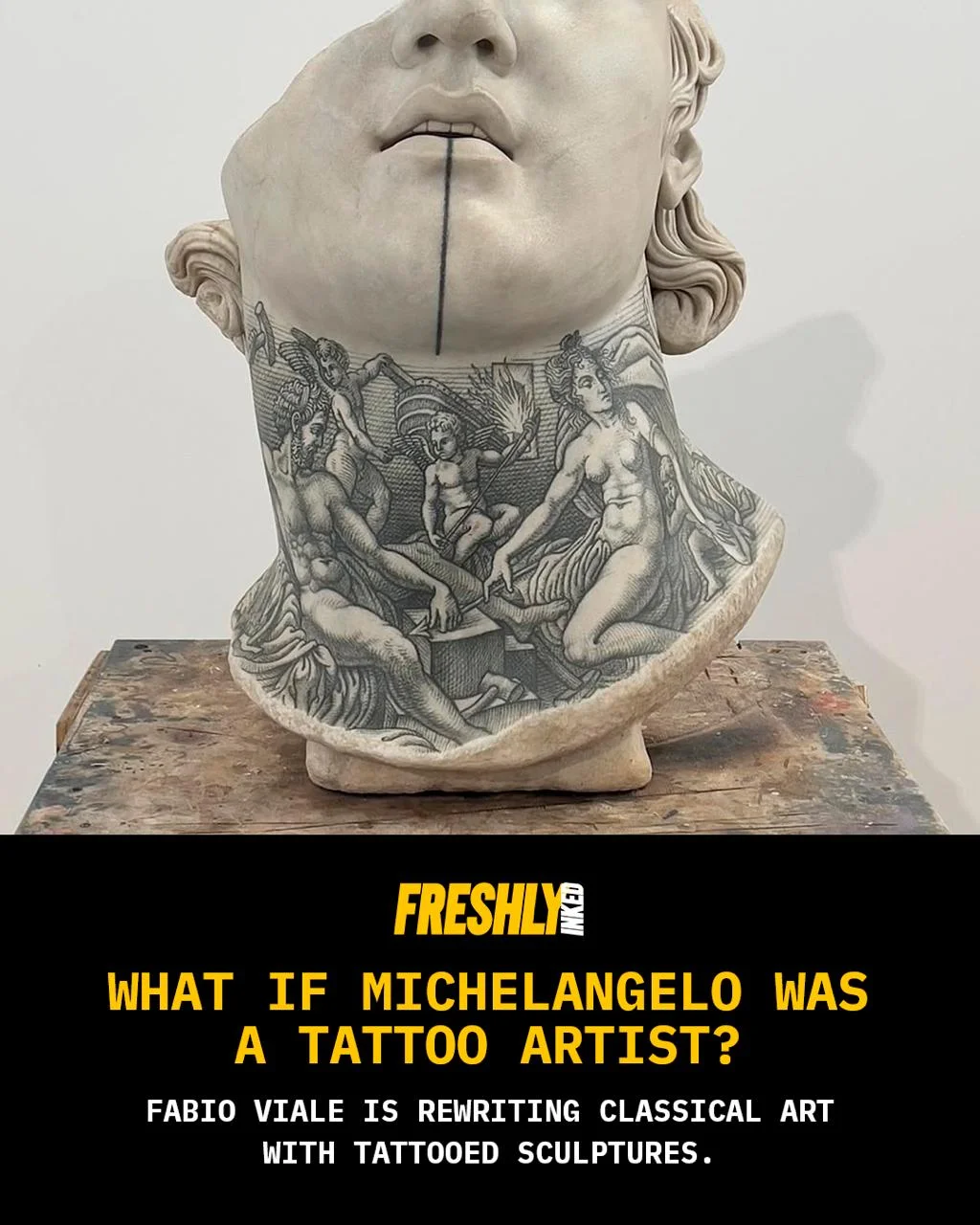
What if Michelangelo was a tattoo artist? Fabio Viale Is Tattooing Classical Sculpture
Italian sculptor Fabio Viale doesn’t sculpt like most do. He tattoos.
Not skin. Not canvas. Marble.
A New Language for an Old Material by Fabio Viale
Working from Pietrasanta, Italy, a town famous for its marble and Renaissance legacy. Viale takes iconic classical sculptures and transforms them with tattoo motifs: Russian prison ink, religious iconography, Yakuza patterns, even Dante’s Inferno.
The result is raw, elegant, and sometimes confrontational.
But always meaningful.
The Sculptures
In Laocoön, Viale removes the sons from the original myth and gives the father a full-body tattoo based on 15th-century paintings of hell.
In Torso Gaddi, he collaborates with Marcelo Burlon, turning a fragment of a body into a fusion of fashion and ancient form.
And in works like Souvenir David, he reintroduces Michelangelo’s hero as a body marked by time, culture, and conflict.
These aren’t updates. They’re fractures. And that’s exactly the point.
Why Ink Instead of Paint?
According to Viale, painting the surface wasn’t enough. He worked with chemists to develop a method that makes the pigment soak into the porous marble, mimicking how tattoos enter the dermis.
Only through this process could he replicate the intimacy, pain, and permanence of real ink.
Symbols, Not Statues
Viale doesn’t invent new forms. He intentionally uses classical figures: David, Laocoön, the Pietà.
Why? Because they’re icons.
Because their survival across centuries has turned them into symbols, not just bodies.
By tattooing them, he shifts the context—without erasing the original.
“I’ve always been drawn to mysteries,” Viale told designboom. “These sculptures led me to understand the artists behind them. To analyze personality through reproduction.”
A Personal, Political, and Spiritual Gesture
Viale’s tattoos carry history, pain, exile, ritual.
They speak to censorship, to displacement, to the body as a canvas for resistance.
One statue features imagery inspired by the Basilica of San Petronio in Bologna—where a 15th-century painting shows the damned in hell, including the Prophet Muhammad. “The terrible thing,” Viale says, “is that the painter signed his name. It shows how hatred has always existedand how it persists.”
His work doesn’t preach. It reflects.
The Weight of It All
In a world obsessed with perfection, Viale makes art that bleeds.
He doesn’t polish history. He cuts into it.
Tattoo by tattoo.
Stone by stone.
And That’s Why It Matters
Because beauty alone doesn’t move people anymore.
Because classical sculpture isn’t finished.
And because marble, when treated like skin, can say something human.
Viale’s work reminds us:
Ink tells stories.
Even when the body is stone.
