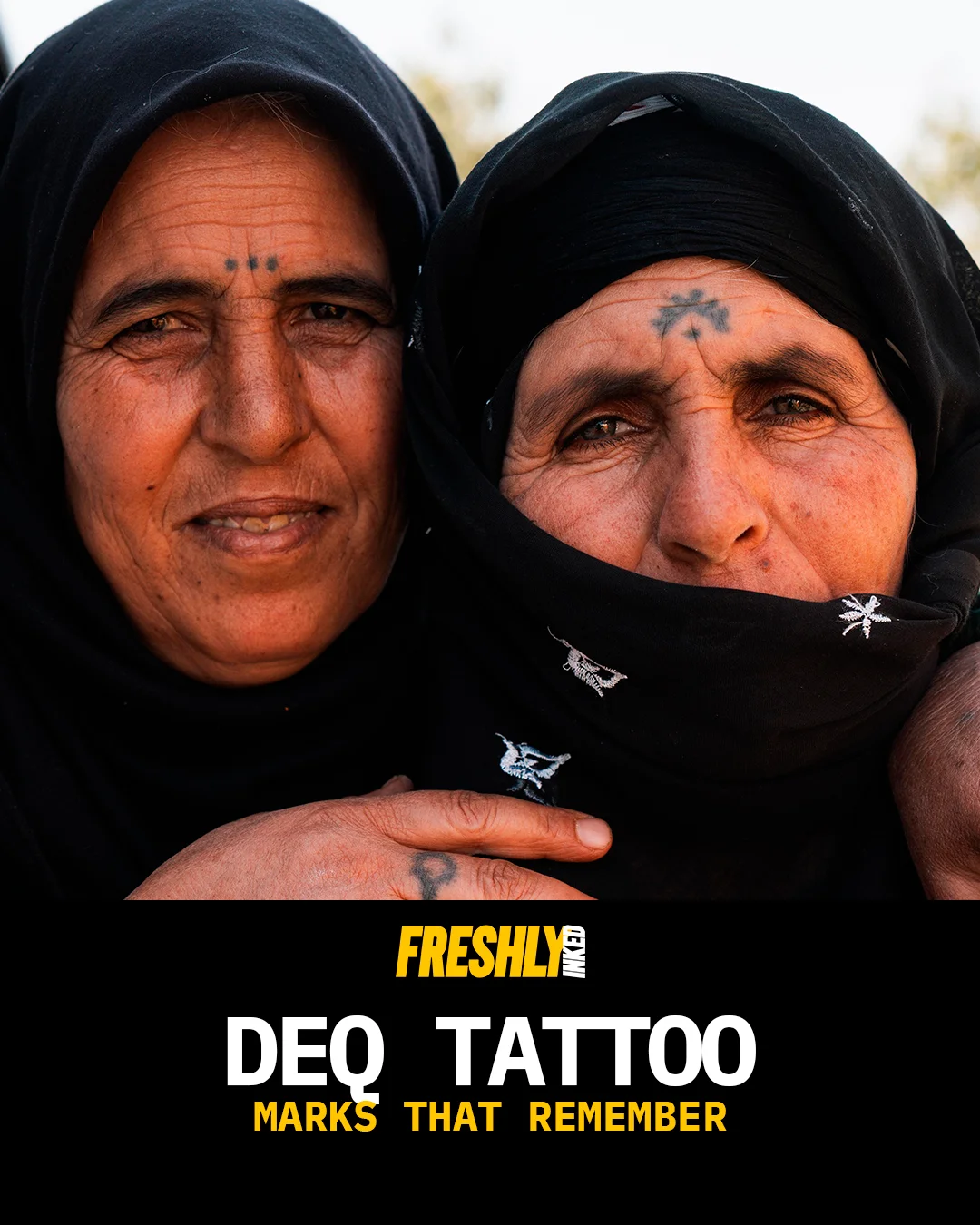
Deq Tattoo: Marks That Remember
There is a silent language that still speaks. Not in words, but in the wrinkles of grandmothers’ hands, in the faded dots on their chins, and in the echoes of patterns on their arms. Deq tattoos are one of the oldest forms of body art in the world. These tattoos are hand-poked symbols carried by Kurdish, Ezidi, and Arab women through generations, in communities in that are located in southeastern Turkey, northern Syria, and Iraq. These tattoos aren’t fashion statements. They mean protection, prayer, identity.
Each mark has meaning; a dot for safety, a cross for fertility, a sun for faith or family lineage.
There was no machines, no studios, no bookings… These tattoos were applied using soot, breast milk of mothers who gave birth to daughters, and thorns or needles. It was women tattooing women in kitchens, under trees, in ritual silence. They protected each other with ink, just like a secret language of care, resistance, and belonging. A tradition whispering through generations.
Yet today, those whispers are fading, and Deq is disappearing.
It’s a culture that is quieted down by religion, migration, stigma, modernization, and fear. And the younger generations no longer carry these ancient marks. Sometimes by choice, and sometimes because no one taught them how.
A Last Chance to Listen to the Echoes of Deq Tattoo Culture
That’s also why we went there.
A team of creators, consisting of photographers, anthropologists, and artists, traveled to Viranşehir and nearby villages to meet the last women who still carry Deq on their skin. We listened their stories. We asked what each symbol meant. We documented how their voices sound, and gestures they use.
These aren’t just tattoos. They tell stories of belonging, survival, and memories that are etched in ink. These women still remember who tattooed them, why, and when. Their stories connect the dots between oral history, spirituality, and defience.
“Creating the space to listen”
Upon hearing about Deq tattoos for the first time, one of the creators shared how deeply struck they were by the raw beauty of the symbols, their meanings, what they represented in the broader context of tattoo culture, and also what it meant for being a woman throughout history.
“What shocked me the most was that it was elderly women who wore these tattoos. And where I come from, tattoos are seen as something for the young. This was the opposite.”
During one of the interviews, the team asked a woman what life had taught her.
She paused, then said:
“Nothing. I just ran. My whole life, I’ve been running to survive.”
This blunt and honest reply silenced the room. She wasn’t just speaking for herself, but for a generation of women who struggled to live amongst war, religion, and hardships. Yet, they still left their mark.
“We realized that almost no one outside this region knows about Deq, because no one has created the space to listen to their stories. And that’s why we came. Because tomorrow, these stories may no longer be told.”
Our aim was to honor their pain by capturing this experience, not glamorize it.
This project became more than a documentary. It became an ethical response to erasure, and a quiet act of protection.
Why It Matters
Our efforts are an act of cultural preservation, before the last ink fades.
Supported by Leica LATAM and Leica Mexico, the project was captured with the precision and care it deserves. But the true power doesn’t reveal itself with the gear or the image. It lies in what it means for all of us:
What stories are we letting disappear? What marks do we carry without even knowing their meaning?
Deq tattoo culture may be dying. But it reminds us that not every sacred thing can be loud. And sometimes the smallest dot can carry the weight of generations.
