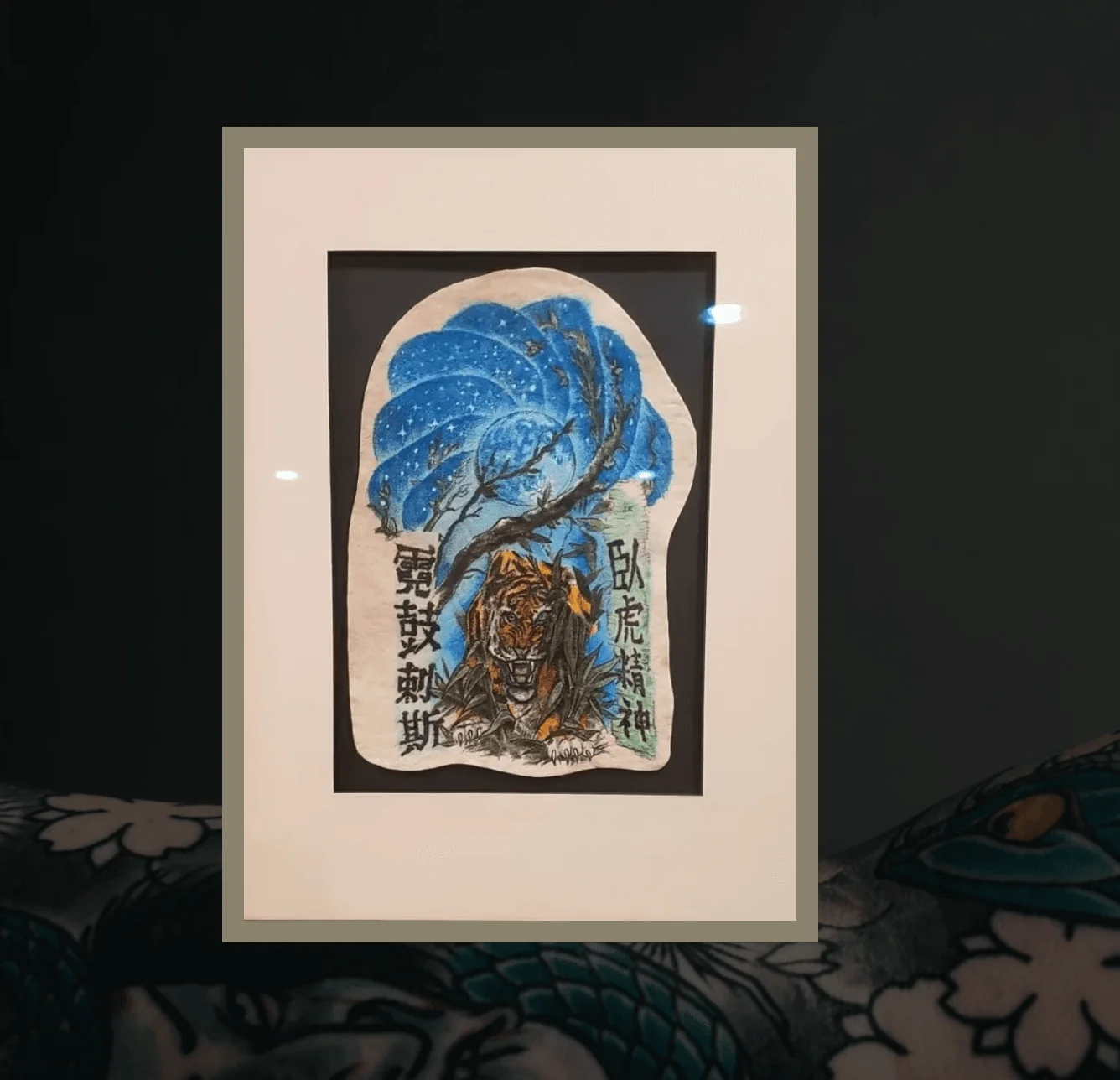
Every form of art has a home in permanence.
Paintings find sanctuary in museums. Sculptures are cast in bronze or marble. Photographs live in albums and cloud drives. Even clothing from bygone eras is preserved in climate controlled archives.
But until now, one form of art, arguably the most personal and permanent while we’re alive, has always died with its canvas.
Tattoos, once buried or cremated with the body, are now being given a second life.
A Radical Act of Preservation
What if the tattoo your brother got to commemorate his sobriety could still hang on your wall after he’s gone?
What if the portrait your wife wore over her heart, of your child, your wedding, your life, could outlive her?
This is no longer hypothetical.
Save My Ink Forever, a pioneering company run by father and son duo Michael and Kyle Sherwood, offers families a new and radical choice: to preserve the tattooed skin of a deceased loved one as framed, museum quality artwork.
For many, it sounds unthinkable. For others, it sounds inevitable.
“Why would you burn or bury a Picasso so no one could ever see it again?”
- Kyle Sherwood, Founder, Save My Ink Forever
That’s the question that sparked a movement.
Tattoos Have Always Been Art. Now They Can Be Heirlooms
Kyle, a licensed embalmer and funeral director, grew up in the deathcare world. He understood grief intimately. But he also understood tattoos. How they hold meaning. How they tell stories that no urn or photo ever fully captures.
Until now, a tattoo died with the person who wore it. For artists, that meant their work disappeared forever, never to be seen, touched, or celebrated again.
But Save My Ink Forever asks: What if that didn’t have to be true anymore?
Using a proprietary preservation process that takes months to complete, the company removes, treats, and mounts tattooed skin in custom frames, returning the final piece to families who want to keep their loved one’s story visible, literally, forever.
It’s not kitsch. It’s not horror. It’s not shock value.
It’s legacy.
Grief Looks Different Now
To some, it may feel extreme. But so is grief.
People wear cremation pendants. Scatter ashes into oceans. Turn remains into diamonds. Tattoo a loved one’s signature across their ribs. Some even mix ashes into tattoo ink.
In that context, preserving a tattoo, something created intentionally to live forever, feels like less of a stretch.
Cheryl Wenzel, who preserved several tattoos from her husband, a tattoo artist, described it as “bringing him back.”
“To me, it was like bringing my husband home. I get to see him every day. He’s not in a box in the closet. I walk past him and I smile.”
- Cheryl Wenzel, wife of preserved artist Chris Wenzel
Chris wasn’t just a collector. He was a creator. His tattoos weren’t decoration. They were chapters in a life devoted to ink. And Cheryl couldn’t imagine letting that work disappear into the ground.
Her choice wasn’t about morbidity. It was about meaning.
Artists Are Starting to See This as Immortality
Tattoo artists spend hours, sometimes days, on a single piece. They shade, stretch, and perfect their work directly onto skin. Unlike canvas or clay, they can’t undo a stroke. There are no do overs.
So when that piece walks out the door, it’s technically finished, but it’s still alive. It’s aging. It’s evolving with the wearer.
But what happens when the wearer dies?
“We put our soul into every piece. But we’ve always known it wouldn’t last.”
- anonymous tattoo artist, quoted by Save My Ink Forever
Until now, death was the end of the story.
But now, artists are watching their work be displayed, not in portfolios, but in actual, physical frames. Their name etched in the corner. Their art still seen. Still admired. Still sparking conversation.
It’s not just about grieving a person. It’s about honoring a collaboration, between artist and collector.
The Shock Factor and the Shift
Kyle is the first to admit this service makes people pause. Some find it disturbing. Others call it morbid. Some dismiss it as “freak show” fodder or imagine it sitting in a Ripley’s museum.
But judgment often melts into curiosity. And curiosity often gives way to awe.
“It’s not grotesque. It’s beautiful. It’s clean. It’s framed. It’s done with reverence.”
- Family member, after receiving her brother’s preserved tattoo
That reverence is what sets this apart. This isn’t trophy hunting. It’s not exploitation. It’s not about shock. It’s about stillness. About memory. About choosing how we preserve the people we lose.
And it opens up bigger questions.
- If we can keep ashes, why not art?
- If we call tattoos sacred while someone’s alive, why do we bury them in death?
- If art is culture, and tattoos are our culture, shouldn’t they be archived just like anything else?
Where This Goes Next
Save My Ink Forever is currently licensing funeral professionals across the country to offer preservation services in their own cities. They’ve created national standards and a roadmap that’s both respectful and scalable.
But this isn’t just a business. It’s a cultural shift.
We are being asked to rethink what it means to leave something behind.
Not just words, or ashes, or photos, but skin. Ink. Stories etched in blood, pigment, and pain.
For centuries, grief has tried to make the intangible tangible. Locks of hair. Worn shirts. Voice recordings. Now, it’s tattoos.
And for the first time in human history, that’s an option. So what does that mean for how we grieve?
What would you choose to preserve, if you had the chance? Whose story would you frame, and why? And what does it say about us, that we’re finally ready to let this kind of art live on?
✍️ Written by the Freshly Inked Editorial Team
📲 Follow @savemyinkforever on Instagram for updates, featured stories, and behind-the-scenes from our preservation process
🔗 Learn more or start your preservation request at savemyink.tattoo